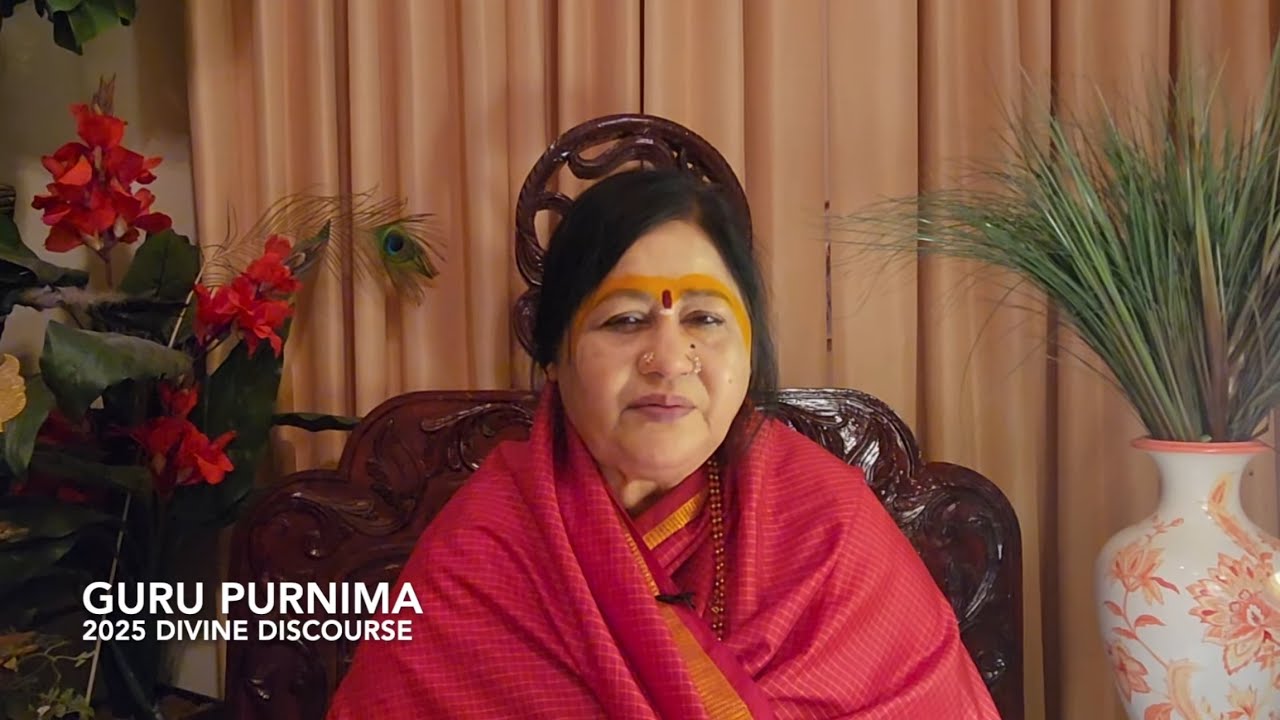
Sri Karunamayi Amma's discourse on Samputita Sri Suktam unpacks the significance of this sacred Vedic hymn dedicated to Sri Mahalakshmi Devi, explaining how chanting and ritualistic worship activate different dimensions of prosperity—material, spiritual, intellectual, and relational. She traces the mantra's metaphysical roots to cosmic creation principles, drawing connections between the feminine divine principle (Shakti), the universe's sustaining force, and the devotee's capacity to receive grace through systematic practice.
What Is Samputita Sri Suktam and Why Does It Matter?
Sri Karunamayi Amma begins by invoking the foundational opening of the Sri Suktam—"Om Hirangyagarbhaya Namah"—linking the sacred sound to the golden womb of creation itself. Samputita Sri Suktam, she explains, is not merely a collection of words but a systematic arrangement of Vedic mantras specifically designed to invoke the blessings of Sri Mahalakshmi, the divine principle of abundance, grace, and material and spiritual well-being.
The practice of chanting this Suktam, according to Amma's teaching, operates on a principle of resonance: the vibrational frequency of the mantras aligns the devotee's consciousness with the cosmic consciousness embodied by the divine feminine. This alignment, she suggests, creates a channel through which prosperity flows—not as luck or accident, but as a natural consequence of attunement to divine law.
Amma emphasizes that the Sri Suktam addresses Lakshmi in her comprehensive forms: as Annapurna (the provider of nourishment), as Gayatri (the universal mother and knowledge-giver), and as Lalita (the divine play of creation and bliss). Each invocation targets a different aspect of human need and spiritual aspiration, making the practice deeply inclusive rather than narrowly materialistic.
How Does the Cosmic Principle of Shakti Relate to Personal Prosperity?
Central to Amma's teaching is the concept of Shakti—the feminine principle of creative power that undergirds all existence. She describes this not as metaphorical but as a living cosmological force. Every atom, every creature, every thought arises from and returns to this primordial Shakti. When a devotee chants Sri Suktam with sincere intention, they are not asking for something external; they are aligning their individual will with the universal will that sustains all creation.
Amma illustrates this by referencing the ancient mythological narrative: the churning of the cosmic ocean (Samudra Manthan) yielded fourteen treasures, among them Lakshmi herself. This story, she teaches, is not historical but metaphysical—it describes the inner process by which consciousness, through discipline and righteous effort (represented by the churning), generates abundance. The devotee who practices Sri Suktam engages in a similar inner churning: they agitate their consciousness through mantra repetition, prayer, and ritual, thereby releasing the latent abundance already present within the fabric of existence.
The principle here is non-dualistic: the Shakti that devotees invoke externally already dwells within them as their own life force and intelligence. Chanting awakens recognition of this truth, dissolving the illusion of lack that keeps individuals spiritually and materially impoverished.
What Types of Prosperity Does Sri Suktam Address?
Amma delineates prosperity across multiple dimensions, refuting the narrow equation of wealth with material possessions. In her discourse, prosperity encompasses:
- Material prosperity: sustenance, home, security, and the resources needed for dignified living
- Intellectual prosperity: clarity of mind, knowledge, wisdom, and the ability to discern dharma (righteous action)
- Relational prosperity: loving family bonds, community support, and harmonious relationships
- Spiritual prosperity: devotion, direct experience of the divine, and freedom from ignorance
- Health prosperity: strength, vitality, and freedom from disease and suffering
The Sri Suktam, she teaches, addresses the whole person. A person may be materially wealthy but spiritually bankrupt; a saint may be materially poor but internally radiant. The Suktam seeks to integrate all dimensions, ensuring that prosperity in one sphere does not come at the expense of another. This holistic vision prevents the spiritual practitioner from attracting wealth through unethical means or from becoming trapped by attachment to material gain.
How Do Ritual and Repetition Activate the Mantra's Power?
Amma explains that mantras are not incantations that magically alter external reality. Rather, they are technologies of consciousness. The human mind is habitually scattered, pulled toward fear, desire, anger, and confusion—what she calls "the obstacles of mind." Through repetitive chanting of Sri Suktam, the mind is systematized; its chaotic energy is channeled toward a single focal point: the form and qualities of the divine feminine principle.
This systematic focus, maintained over time through sincere practice (sadhana), gradually transforms the practitioner's internal state. Obstacles dissolve not because a deity removes them, but because the practitioner's consciousness shifts from scarcity-consciousness to abundance-consciousness, from separation to unity. As this shift occurs, the devotee's actions naturally become more aligned with dharma; they attract different circumstances, relationships, and opportunities than they did before.
Ritual practice—whether it be puja (worship), abhisheka (ritual bathing of the deity's image), or tarpana (offering)—adds a tangible, embodied dimension to the practice. The body and the senses are engaged, making the practice accessible not only to the intellectual mind but also to the heart and the intuitive faculties. When the whole person—mind, heart, body, and spirit—is oriented toward the divine through ritual and mantra, the results are exponentially more powerful than intellectual belief alone.
What Does Amma Teach About the Relationship Between Karma and Prosperity?
Amma does not present Sri Suktam as a shortcut that bypasses the law of karma. Instead, she teaches that the practice of chanting and worship refines the devotee's karma. Those who invoke Lakshmi with selfish intent and then hoard wealth breed new karmic debts. But those who chant with recognition that Lakshmi is the universal mother, that abundance is meant to flow through them for the benefit of all beings, transform their relationship to prosperity itself.
In this understanding, Sri Suktam is a practice of purification. It dissolves the three veils of ignorance—avidya (not-knowing the true nature of self), asmita (ego-based identity), and raga-dvesha (attachment and aversion). As these obstacles clear, the devotee naturally becomes a cleaner instrument for divine grace. Prosperity that flows through a purified consciousness benefits not only the individual but radiates outward, healing families, communities, and the world.
How Does Samputita Differ From Other Forms of Sri Suktam?
While Amma's discourse does not exhaustively differentiate variants, the prefix "Samputita" suggests a wrapped or enclosed form—a condensed, concentrated version that holds the essential power of the full Sri Suktam in a more manageable form for regular chanting. This is significant for householders and busy practitioners who may not have hours for extended ritual but can dedicate daily time to the practice.
The accessibility of the condensed form does not diminish its efficacy; rather, it democratizes the practice, making the blessings of Mahalakshmi available to all sincere devotees regardless of their external circumstances or expertise in Sanskrit.
What Is the Role of Devotion (Bhakti) in the Practice?
Amma repeatedly emphasizes that mechanical chanting without devotion is hollow. The words alone are neutral; they become living force only when infused with sincerity, gratitude, and love. A person chanting Sri Suktam while harboring resentment, greed, or contempt for others blocks the mantra's power just as a blocked valve blocks the flow of water.
True devotion, in Amma's teaching, is not sentimentality but a radical reorientation of the heart toward the divine. It is the willingness to see Lakshmi not as a means to selfish ends but as the compassionate mother who sustains all beings. When this recognition blooms in the heart, the chanting becomes a love letter, a prayer, a conversation with the infinite. In this mode, the mantra becomes transformative.
Where to go from here
For practitioners drawn to Amma's teaching, the next step is to establish a regular chanting practice, ideally at the same time each day, in a clean and quiet space. Begin with an understanding of the mantra's meaning—not merely as Sanskrit words but as expressions of cosmic principles. Pair the chanting with a simple offering (flowers, fruit, incense, water) to establish the ritual dimension. Over time, as the practice deepens, the benefits—both seen and unseen—will accumulate. Trust the process, maintain consistency, and allow the divine feminine principle to reshape your relationship to abundance, both inner and outer.